A modern man’s guide to family planning


Today, men are thinking carefully about when and how to have children, balancing career goals, relationships, and biological realities. Understanding male fertility, planning for fatherhood, and considering options like sperm freezing can empower men to make informed choices.
Family planning is no longer just a woman’s responsibility. Male family planning is increasingly recognized as essential. Today, men are thinking carefully about when and how to have children, balancing career goals, relationships, and biological realities.
Understanding male fertility, planning for fatherhood, and considering options like sperm freezing can empower men to make informed choices. Male fertility begins a gradual decline in the mid-30s and accelerates after 40. Early awareness helps men align family goals with biological realities and ensures that personal and professional priorities do not limit future reproductive options, and can change how men plan for kids in the 21st century.
Let’s explore our guide to male family planning, including when men should freeze sperm and other tips on planning for fatherhood in the future.
Key takeaways
- Male fertility declines with age, affecting sperm quality, motility, and DNA integrity.
- Delaying fatherhood may increase time to conception and the need for assisted reproductive technologies.
- Advanced paternal age can influence offspring development, including neurodevelopmental and psychiatric outcomes.
- Proactive planning, including sperm preservation, provides flexibility and peace of mind.
The reality of having children later in life — for men
While waiting to have children can offer advantages, such as financial stability and emotional maturity, balancing these benefits with biological realities ensures men make confident and realistic decisions about family planning. Let’s dive in to understand how male fertility declines and how that can impact your family-building experience later in life.
Average age of first-time fathers
The average age of first-time fathers in the United States has been on the rise for about 40 years. In an analysis of over 168 million births, Stanford researchers found that average paternal age in 2022 was 32.1 years old.1 This is nearly 5 years higher than it had been in 1972.2
Learn more: How old are American dads?
Benefits of planning for fatherhood later in life
Having kids later in life certainly offers some advantages: improved financial stability, better emotional maturity, and stronger partnerships. Men in their late 30s, early 40s, or even those starting fatherhood after 50 often have more clarity about parenting priorities, resources, and lifestyle choices. These advantages can create a supportive environment for raising children.
For example, according to data from the Federal Reserve, Americans between 45 and 55 have an average of $48,000 in savings, compared to $11,000 for Americans under 35.3 And a 2012 survey revealed that 57% of those who became fathers after 40 felt that their emotional maturity was an advantage of having children later in life.4
However, when we’re considering how men plan for kids, we need to balance these benefits with biological realities — the way male fertility declines with age — to ensure men can pursue life goals without compromising reproductive potential.
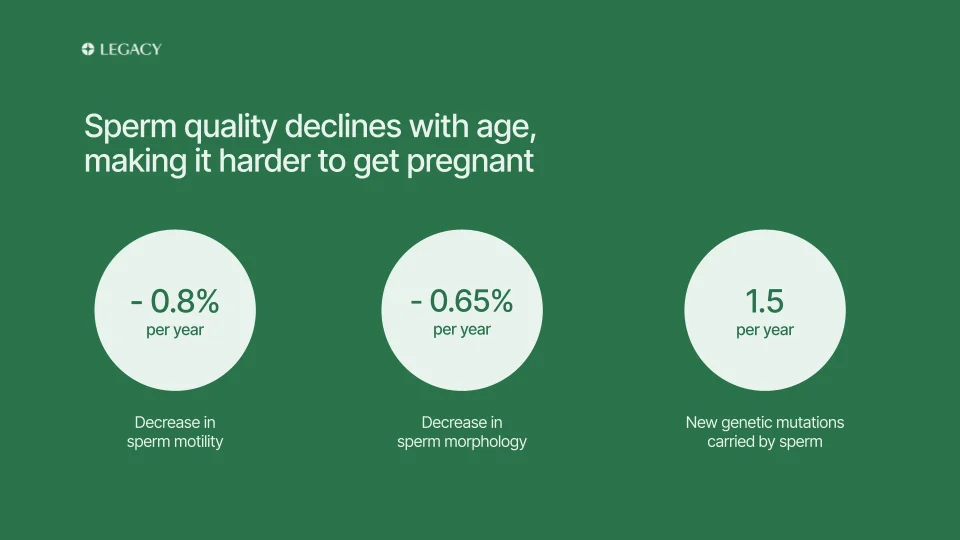
How male fertility declines with age
Men do not experience a sudden fertility cutoff at age 35, 40, or even 45. Rather, many factors impacting male fertility can decline with age.5,6,7 These metrics include:
- Semen volume, the amount of liquid a man ejaculates
- Sperm motility, the percentage of sperm that are moving or “swimming”
- Sperm morphology, the percentage of sperm that are the proper size, shape, and structure
- DNA integrity, the percentage of sperm that are carrying undamaged DNA
As a result, “advanced paternal age” can increase a couple’s risk of infertility and miscarriage, and can influence offspring neurodevelopmental and psychiatric outcomes.8 Waiting longer to have children can increase your reliance on assisted reproductive technologies, such as IVF. Natural conception remains possible, but it may take longer and sometimes require more cycles.6
Learn more: How age impacts male fertility
Costs and considerations of assisted reproductive technology
As male fertility declines with age, couples may turn to in vitro fertilization (IVF) or other interventions. In fact, research has found that men over 50 are 2.23 times more likely to need the help of ART to have a child.1
These procedures can be expensive — think $12,000–$30,000 or more — and emotionally demanding. Being aware of potential costs and success rates allows men to plan both financially and emotionally for family building, reducing stress if interventions become necessary.
Sperm freezing as an insurance policy for male family planning?
Many women have heard of egg freezing as a way to preserve fertility for the future. But what about reproductive planning for men? You can freeze, too — sperm cryopreservation preserves younger, healthier sperm for future use, offering flexibility and peace of mind while you balance life priorities.
Common scenarios include founders delaying children until after a career milestone, consultants with demanding travel schedules, divorced fathers planning a second child, and younger men who are uncertain about timing. When should men freeze sperm? The younger, the better, but before age 35 is ideal to ensure you’re freezing the healthiest possible sperm.
5 questions every man should ask when planning for fatherhood
Men should treat family planning as an ongoing process rather than a one-time decision. Early planning provides options, reduces stress, and allows men to pursue life goals without compromising reproductive potential.
What does my ideal family look like?
Before thinking about timing, imagine the family you want. Maybe you grew up with many siblings, and always envisioned yourself with a big, noisy family of your own crowded around the dining room table. Maybe you’ve always wanted to be a dad, but you’re not so concerned with the biological connection, and other methods of family building (like adoption, fostering, raising step-kids, or using donor sperm) would be fine with you. Or maybe you’re not even sure you do want kids, but you want to keep your options open in case that changes down the road.
Picturing the family that you want helps you plan ahead more comprehensively. If you’re absolutely sure you want biological kids — especially if you want multiple — you may want to be more proactive about fertility testing and preservation.
When can I realistically picture myself having children?
As we’ve discussed, men do have a biological clock to consider. Men produce sperm throughout life, but research shows that sperm quality — including motility, morphology, and DNA integrity — declines after 35.5,6,7
Early awareness allows you to make informed decisions about timing, lifestyle changes, and fertility preservation. Sperm freezing is most effective when sperm are younger and healthier. Planning in advance can also reduce the need for more invasive or costly interventions in the future.
How does this align with my relationship and career trajectory?
Reproductive planning for men should consider relationships, career goals, financial readiness, and lifestyle. Men delaying fatherhood due to professional commitments often benefit from sperm freezing, which provides flexibility without pressure.
What would I regret at 50?
Considering potential regrets clarifies priorities. Would you regret not having children at all? Feeling pressured into fatherhood before you were ready? Not preserving options when it was biologically easier? Planning in your 20s and 30s helps reduce future stress and ensures decisions reflect long-term goals rather than immediate circumstances.
Is there anything I can do now to improve my chances of having kids in the future?
Yes! You can take several practical steps to optimize your future fertility:
- Schedule a baseline semen analysis
- Optimize nutrition, exercise, and sleep
- Reduce alcohol and smoking
- Understand the impact of any medical treatment, especially testosterone therapy
- Consider sperm freezing as an insurance policy
“I would absolutely recommend people freeze, especially if they think they’re going to be conceiving at a later age. Studies show that you simply are going to have better sperm parameters and semen quality in your youth, so the earlier you are able to bank a sample, the better quality that’s going to be.”
— Male fertility nurse and Legacy Director of Clinical Services Stephanie Sabourin
You're ready to start a family. But are your sperm?

Real-life male family planning scenarios:

The Founder: Built a startup and froze sperm in his late 20s, preserving options until a company exit at 38.

The Consultant: Travels internationally and froze sperm to avoid pressure later.

The Divorced Dad: Wants a second child and uses stored sperm to coordinate timing with a new partner.

The 25-Year-Old: Unsure about parenthood, froze sperm to keep future options open.
These examples show how men at different life stages can incorporate reproductive planning into their overall life strategy, preserving flexibility while making informed decisions.
References
- Ha et al. “Sociodemographic Trends and Perinatal Outcomes in Fathers 50 Years and Older,” 2024.
- Khandwala et al. “The age of fathers in the USA is rising: an analysis of 168 867 480 births from 1972 to 2015,” 2017.
- Federal Reserve. “Changes in U.S. Family Finances from 2019 to 2022: Evidence from the Survey of Consumer Finances.” 2023.
- Mac Dougall et al. “‘Inconvenient biology:’ advantages and disadvantages of first-time parenting after age 40 using in vitro fertilization,” 2012.
- Xie et al. “Increasing age in men is negatively associated with sperm quality and DNA integrity but not pregnancy outcomes in assisted reproductive technology,” 2025.
- Castellini et al. “Relationship between male aging and semen quality,” 2024.
- Jimbo et al. “Fertility in the aging male: a systematic review,” 2022.
8. Malaspina et al. “Paternal age and mental health of offspring,” 2015.
Find what's right for you


Standard Semen Analysis
$295
Key features

Semen volume
Sperm concentration & count
Motility
Morphology