Average age of fathers in the United States: Paternal age trends in the latest data (2026)



How old are American dads? Men are becoming fathers later in life, a trend that’s been building for decades and shows no signs of slowing down. Let’s explore the average age of fathers in 2026, and break that down to explore paternal age in major US cities, compare US paternal age vs. older countries, and understand the potential fertility and pregnancy impacts of older fathers.
How old are American dads? Men are becoming fathers later in life, a trend that’s been building for decades and shows no signs of slowing down. Let’s explore the average age of fathers in 2026, and break that down to explore paternal age in major US cities, compare US paternal age vs. other countries, and understand the potential fertility and pregnancy impacts of older fathers.
Key takeaways
- Average paternal age in the United States has risen from 27.6 in 1970 to 32.1 in 2022, increasing 4.5 years over a period of 5 decades. Maternal age has increased over the same period.
- Age at fatherhood is correlated with race, geography, and education, and can be impacted by a number of sociocultural trends, such as higher education and increased cost of living.
- There are pros and cons to having kids later in life. While older fathers tend to be more financially and emotionally stable, sperm quality declines with age, making it more difficult to have a healthy baby after age 40.
How old are American fathers in 2026?
The most recent peer-reviewed data we have is from 2022. A study of over 46 million births between 2011 and 2022 found that, in 2022, the average age of an American father at his child’s birth was 32.1. Ten years prior, in 2011, it was 31.5.1
So, while we don’t have exact data on the average paternal age in 2026, we can estimate it’s around age 32 — or a bit older, if trends hold.
Fathers over 40 now account for about 9% of all US births, based on data through 2015. That might not sound like a huge number, but it represents a significant shift: this percentage has doubled since the 1970s, when fathers over 40 made up just 4.1% of births.2
Fathers aged 50 and older remain a smaller group, but they’re growing too. In 2022, 1.3% of all births involved fathers aged 50 or older, compared to 1.1% in 2011.1 That means that today, roughly 40,000 newborns each year have a father over age 50.
Some men become fathers much later than average. From 2011 to 2022, 47,785 births involved fathers aged 60 or older — that’s 0.1% of all births.1 Fathers aged 70 and above account for even smaller numbers, with 3,777 births (0.008%) in this category. Breaking this down further: fathers aged 65 to 69 accounted for 10,008 births, those aged 70 to 74 for 2,820 births, fathers aged 75 to 79 for 692 births, and men 80 and older fathered 265 children during this period.
Learn more: Fatherhood after 60

How paternal age has increased over time
The numbers tell a clear story: fatherhood keeps getting later. Over five decades, the average age of fatherhood has climbed 4.5 years.
Back in 1972, fathers averaged just 27.4 years old at their children’s births, according to a Stanford analysis of over 168 million US births.2 By 2015, that figure had reached 30.9 years. The upward trend continued into the following decade, reaching that 31.5 average for the 2011–2022 period.1
According to the Stanford study:
Paternal age vs. maternal age in the US
Women have been delaying parenthood, too. In fact, maternal age rose at an even faster pace than it did for fathers. Between 1972 and 2022, the average age of mothers rose from 24.5 to 29.5.3.4 That’s a 5-year increase, compared to the 4.5-year rise in paternal age over the same timeframe.
The age gap between mothers and fathers has shrunk just a bit. In 1972, fathers were, on average, 2.9 years older than mothers. In 2022, the gap averages 2.6 years.
What impacts paternal age?
The shift toward later fatherhood doesn’t affect all men equally. Education, race, and geography all play a role in when men start families.
More educated men have children later
Between 2011 and 2015, fathers with college degrees averaged 33.3 years old at their children’s births, compared to 29.2 years for those with only a high school diploma.2 That four-year gap reflects the extended time college-educated men spend building careers before they feel ready to start families. In other words, education creates a four-year gap in paternal age.
The pattern becomes even clearer when you look at first-time fathers. Among less educated men, 70% had their first child before age 25, while only 14% of college-educated men became fathers that young.2
Research from Denmark reveals an interesting pattern: there are actually two distinct groups of men who father children at advanced ages. One group includes men with high educational levels and relatively high incomes (think doctors, lawyers, and executives who spent their 20s and 30s building careers).5 The other consists of men with low educational levels, minimal connection to steady employment, and relatively low incomes.
Race & ethnicity is correlated with paternal age
Asian fathers represent the oldest group overall, with Japanese fathers showing the most striking change — from an average of 30.7 years in 1972 to 36.3 years in 2015. Chinese fathers averaged 34.7 years, while White fathers came in at 31.1 years. Hispanic fathers tended younger at 30.0 years, with Black fathers at 30.4 years.2
US regions with the youngest dads
Where you live matters too. The Northeast — including New York, New Jersey, Pennsylvania, and the New England states — consistently reports the oldest fathers across all time periods measured, though paternal age has increased in every region of the United States.
Fathers in the Western part of the country as well as the Midwest are slightly younger, averaging 30.4 and 30.3 years old respectively. Dads in the American South, including Texas, are the youngest on average.2
While state-by-state analysis of paternal age is not currently available, we can look at maternal age to understand how geography impacts the age at which Americans are starting families. A 2016 analysis of birth records by the New York Times also found that maternal age was highest in the Northeast and the West, and lowest in the South.6 Parental age tended to be higher in regions with higher cost of living and average income, as well.
The US counties and independent cities with the highest maternal age at first birth:
- San Francisco County, CA — 31.9 years old
- Manhattan, NY — 31.1 years old
- Pitkin County, CO (including Aspen) — 31.1 years old
- Falls Church City, VA — 31.1 years old
- Marin County, CA — 31.1 years old
- Arlington County, VA — 31.0 years old
- Teton County, WY (including Jackson) — 30.6 years old
- Norfolk County, MA (including Braintree, Quincy, and Brookline) — 30.3 years old
- Alexandria City, VA — 30.3 years old
- Middlesex County, MA (including Cambridge, Concord, and Newton) — 30.2 years old
Read more: Parental age on the rise in US cities
Paternal age in the US vs. other countries
When it comes to rising paternal age, American trends mirror global patterns, especially in the West. Research has shown that, like the US, most European countries have seen a significant increase in average paternal age over the past 4–5 decades.7
According the UN, in 2021, the 10 countries with the highest average parental age (both mother and father factored in) were:
- Hong Kong — 32.8 years old
- South Korea — 32.5 years old
- Bermuda — 32.2 years old
- San Marino — 32.2 years old
- Ireland — 32.2 years old
- Luxembourg — 32.2 years old
- Spain — 32.0 years old
- Andorra — 32.0 years old
- Switzerland — 32.0 years old
- Italy — 32.0 years old
The United States is 90th on the list (of 236), with an average parental age of 29.6.8
How much do you know about your sperm?

Why men are becoming fathers later in life
What’s driving this shift toward later fatherhood? The answer isn’t simple. It’s a combination of economic, social, and technological changes that have reshaped how and when people build families.
Men desire career & financial security before children
Money matters, and it’s often the biggest factor. According to a 2023 interview of 23 hopeful parents, men increasingly want to establish themselves professionally and achieve some level of economic security before taking on parental responsibilities.9 This desire for financial readiness reflects what many in the study saw as “prerequisites” for having children: “financial security, a suitable home and a steady relationship.”
Education plays a major role too. As more men pursue college degrees and advanced education, those years spent in classrooms and laboratories naturally push back family planning timelines. The time required to fulfill personal and professional ambitions, combined with shifting social norms about when it’s “appropriate” to become a parent, creates life trajectories that are far less predictable than what previous generations experienced.
One man interviewed in the study above was a highly educated academic. He reflected, “To get a long-term position rather than a two, three-year post-doc [post] is a big step in academia… To take a year or two out looking after kids or take on the responsibility of kids before you’ve got that is, I think, well I would have been nervous about it to be honest and I know many people are.”9
Women are focusing on their careers more than ever before
It’s not only fathers’ educational and career opportunities that are impacting family timelines. Women’s integration into the workforce has fundamentally changed family planning dynamics. Between 1948 and 2000, the percentage of working-age women employed or seeking employment nearly doubled, from 33% to around 60%.10 This shift means couples now coordinate dual careers when deciding the right time to start families.
Medical technology gives more control over family timing
Better contraception has given couples unprecedented control over timing. Reliable, widespread birth control methods allow people to prevent unplanned pregnancies and time parenthood according to their circumstances.
Similarly, assisted reproductive technology has extended reproductive windows, giving older parents who might have struggled with fertility in the past new options to conceive.
How does paternal age impact fertility?
Here’s something that may not surprise you: men worry less about their biological clock than women do. Many men perceive fewer age-related fertility constraints than women face, which can contribute to delayed fatherhood. While women hear constantly about declining fertility after 35, men often assume they can father children well into their later years without consequence.
In the aforementioned interviews of those delaying parenthood, researchers noted that “whilst both women and men recognised the downsides of delaying parenthood in terms of the limitations of physiological aging, for men, the implications were expressed more in terms of physical fitness, their identities as fathers, and their fears relating to, for example, being seen as a ‘fat dad’ or the ‘oldest dad in the playground’” — vs. fears about fertility decline with age.9
However, age does affect male fertility, and the changes can impact both how easily couples conceive and the health outcomes for their babies.
Male fertility changes with age
The research is clear: getting pregnant becomes harder when men reach their late 30s and 40s. In a study of over 8,500 pregnancies, researchers found that, compared to men under 25:
- Men aged 30–34 were 38% less likely to conceive within a 12-month period.
- Men ages 35 and up were 49–50% less likely to conceive within a 12-month period.11
In another study, women with partners aged 45 or older face nearly five times longer time to conceive than those with partners aged 25 or under. Researchers emphasized that this was not solely because older men tended to have older partners — even the sub-group of couples composed of a woman under 25 and an older male partner experienced time-to-pregnancy that was 400% higher than couples with a younger male partner. Researchers concluded that “the negative effect of increasing the man’s age is independent of the effect of the woman’s age.”12
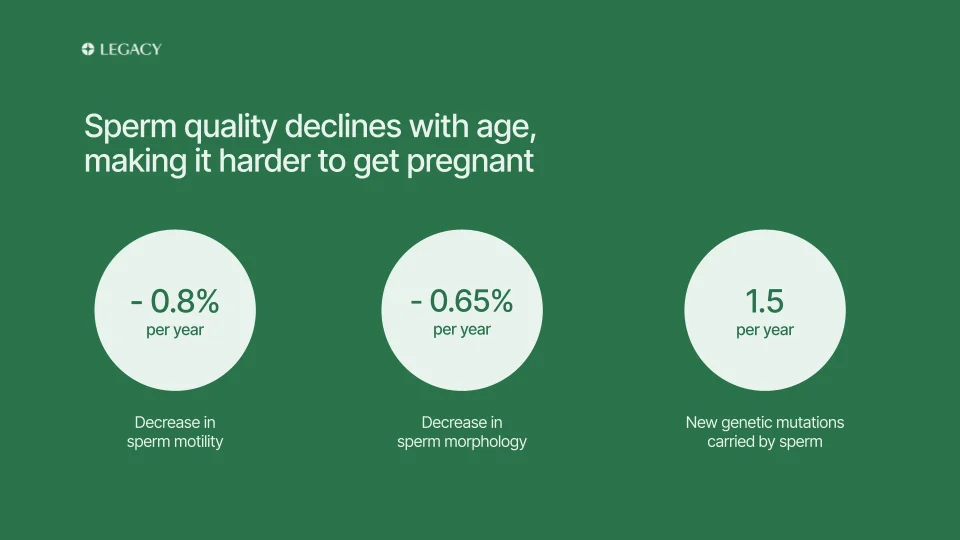
What happens to sperm quality with age
What is happening to male fertility that’s making it harder for couples with older male partners to get pregnant? Sperm health takes a hit as men age, and the changes are gradual, but substantial.
A large meta-analysis of research looking at the decline of male fertility with age found that nearly every sperm parameter, or measure of sperm health, declines year-over-year of a man’s life.13
Learn more: How age impacts male fertility
When natural conception becomes difficult, older fathers turn to assisted reproductive technology (ART), like IVF, more often. Men in their 50s are more than twice as likely to use ART to become fathers.1
Health risks that come with older fathers
In part due to the decreased DNA integrity of older sperm, advanced paternal age carries real health risks for children. Research links older fathers to an increased risk for many conditions in their offspring:
- Autism spectrum disorder
- Psychiatric illness including schizophrenia
- Neurologic disease such as neurofibromatosis
- Pediatric cancer
- Chromosomal abnormalities
Sperm quality may even affect a baby’s — and their mother’s — health during the pregnancy. According to a large population-based cohort study published in 2018, babies born to fathers 45 or older faced 14% higher NICU admission rates, 14% increased prematurity risk, 18% higher likelihood of seizures, and 14% higher chance of low birth weight.14 That same study found that partners of men 45 and older were 28% more likely to develop gestational diabetes.
Sperm freezing: protecting male fertility before it declines
If, like many in the United States, you’re hoping to have kids later in life, what can you do now? Sperm freezing offers a solution for men who want to preserve their fertility to have a healthy family whenever they’re ready. After being frozen, sperm remains healthy and viable for decades. Think of it as an insurance policy — protecting your future family options while your sperm is still at its peak.
Explore sperm freezing from home
References
- Ha et al. “Sociodemographic Trends and Perinatal Outcomes in Fathers 50 Years and Older,” 2024.
- Khandwala et al. “The age of fathers in the USA is rising: an analysis of 168 867 480 births from 1972 to 2015,” 2017.
- National Vital Statistics Report. “Mean age of mother, 1970-2000,” 2002.
- National Vital Statistics Report. “Trends in Mean Age of Mothers: United States, 2016–2023,” 2025.
- Kornerup et al. “Social, demographic and health characteristics of men fathering children at different ages,” 2021.
- Bui et al. “The Age That Women Have Babies: How a Gap Divides America.” New York Times, 2018.
- Dudel et al. “Shifting Parental Age Differences in High-Income Countries: Insights and Implications,” 2023.
- United Nations Department of Economic and Social Affairs. “World Population Prospects 2024,” 2024.
- Datta et al. “Factors shaping the timing of later entry into parenthood: Narratives of choice and constraint,” 2023.
- US Department of Labor. “Working Women: Data from the Past, Present and Future,” 2023.
- Ford et al. “Increasing paternal age is associated with delayed conception in a large population of fertile couples: evidence for declining fecundity in older men. The ALSPAC Study Team (Avon Longitudinal Study of Pregnancy and Childhood),” 2000.
- Hassan et al. “Effect of male age on fertility: evidence for the decline in male fertility with increasing age,” 2001.
- Harris et al. “Fertility and the Aging Male,” 2011.
14. Khandwala et al. “Association of paternal age with perinatal outcomes between 2007 and 2016 in the United States: population based cohort study,” 2018.
Find what's right for you


Standard Semen Analysis
$295
Key features

Semen volume
Sperm concentration & count
Motility
Morphology