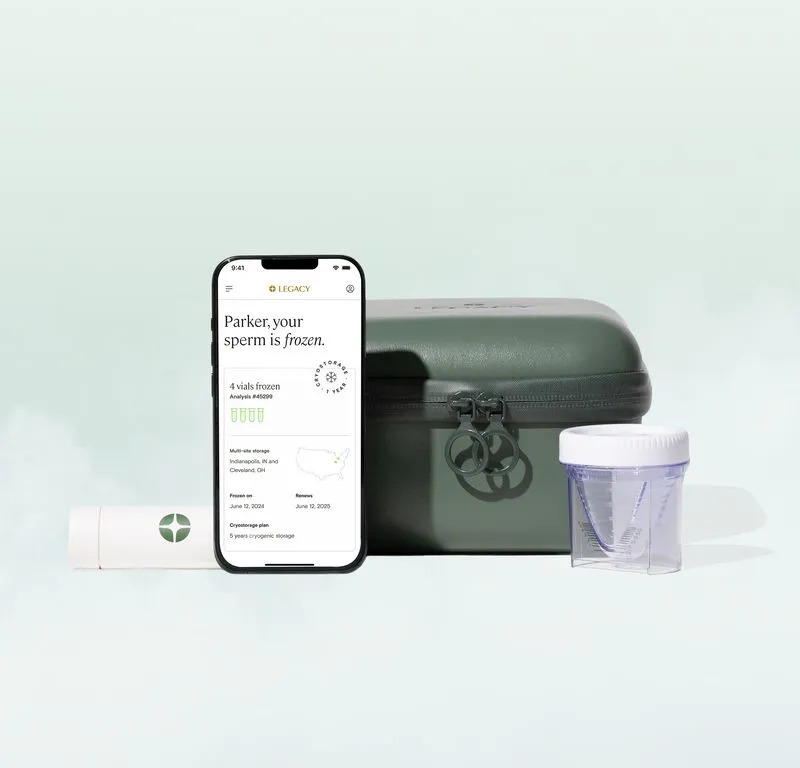
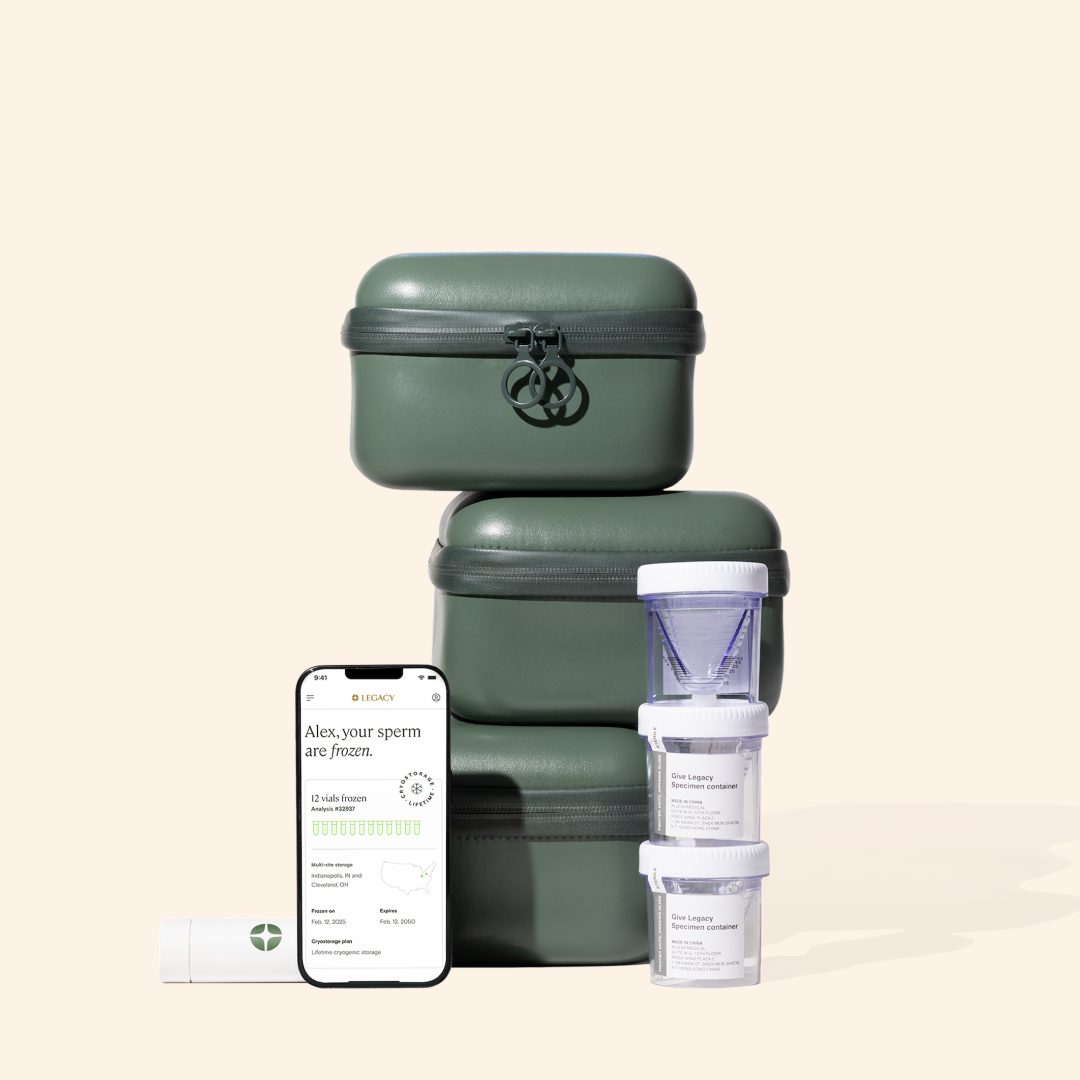
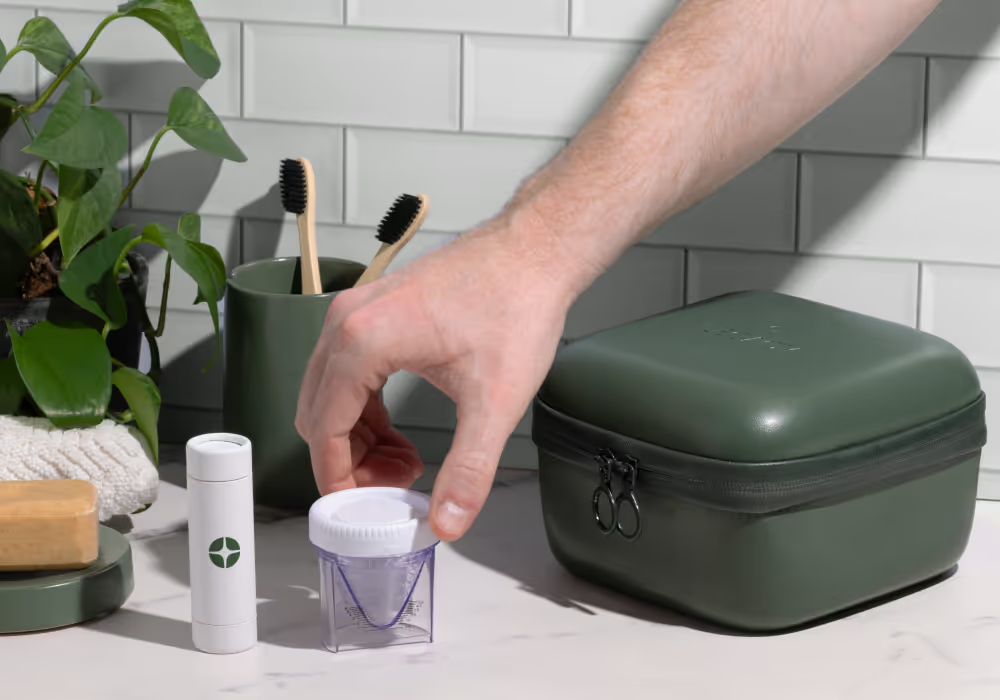
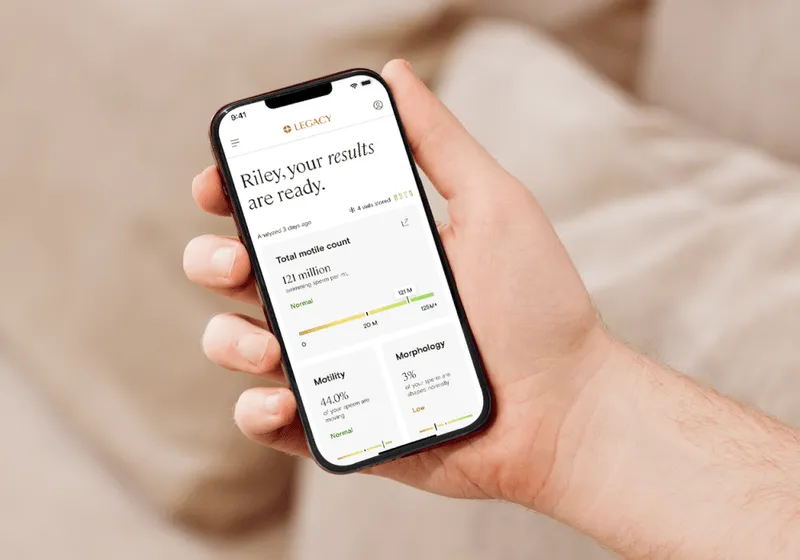
If you have frozen sperm available, you can attempt a pregnancy in the future without stopping your hormone therapy. Legacy works with more transitioning clients than any other digital fertility clinic.
Recommended for people trying to have a baby so you have a complete picture of the fertility equation.

1 year of storage for 1 sample (renewable)
1 collection kit
Pre-freeze STI test
Advanced fertility testing
2 samples, 5 years of sperm freezing (renewable)

5 years of storage (renewable)
2 collection kits for 2 samples
Pre-freeze STI test
Advanced Semen Analysis
3 samples, 25 years of sperm freezing

25 years of storage
3 collection kits for 3 samples
Pre-freeze STI test
Advanced Semen Analysis
Absolutely yes. We have helped more than 2,000 transitioning people preserve their fertility. We work with clients at various stages in their gender transition every day. Our care team has been trained by Folx to provide an inclusive, affirming experience to every client, no matter what their fertility journey.
We partner with several trans healthcare providers, including Folx, Children’s Hospital of Philadelphia, and Anchor Health Connecticut, to provide fertility preservation directly to the trans community.
Yes. We must use your legal name on your contracts and paperwork. However, we’ll ask for — and use — a preferred name during onboarding, on your client dashboard and in all client services communications. We want every client to feel as comfortable as possible during this process.
Yes! Anyone who produces sperm can use Legacy for sperm freezing. At-home sample collection is a more accessible, comfortable, and affordable option for sperm freezing.
Gender-affirming hormone therapy, including estrogen and androgen-blockers (also known as “T-blockers”), is likely to impair or even halt sperm production.
The effect seems to be dose-dependent. In one study, researchers found that low-dose estrogen therapy had no impact on sperm concentration or motility, while a higher-dose regimen resulted in reduced sperm motility after just a few days and reduced sperm concentration after 2 weeks.
We recommend freezing sperm before starting hormone therapy, in order to freeze the highest quality of sperm possible. The higher the quantity and quality of sperm, the more likely it is that you’ll be able to create a pregnancy with that sperm in the future.
However, we know this isn’t always possible, and that in many cases, people will begin hormone therapy prior to exploring fertility preservation. It may still be possible to freeze sperm even after starting GAHT/HRT. We recommend a semen analysis to assess fertility before freezing.
Not necessarily. It takes time for your hormone therapy to affect your fertility. Additionally, hormone therapy affects each person differently. After taking gender-affirming hormones for months or years, you may still produce some sperm. The quantity and quality of sperm may deteriorate progressively the longer you’ve been taking HRT.
If you’re already taking hormone therapy, we recommend starting with a semen analysis. This test will assess the quality of your semen and determine whether your sample is viable for freezing.
If you do a semen analysis with Legacy and have viable sperm, you can upgrade your purchase to include freezing, and freeze that sample immediately.
If you don’t have viable sperm, you can consider pausing your hormone therapy for 3–6 months to see if sperm production resumes before continuing with the fertility preservation process.
Gender-affirming surgery for trans women typically includes orchiectomy, the removal of the testes. Orchiectomy will result in irreversible, total sterility.
If you plan to undergo vaginoplasty, vulvoplasty, or orchiectomy and may want a biological child in the future, we highly recommend freezing at least 3 semen samples to maximize the chances of creating a healthy pregnancy.
Maybe. The “sperm cycle” — how long it takes to produce new sperm — is about 3 months, so you will likely have to pause hormone therapy for at least this long in order to recover fertility. One study found that within 6 months of stopping estrogen therapy, 67% of subjects regained a normal sperm count. That means about 1 of every 3 trans women may be unable to recover their fertility after beginning a medical transition.
Short answer: as many as you can afford. But the ideal number of samples to store also depends on your future plans. A few questions you might consider:
Generally speaking, one vial of sperm is used in each IUI or IVF procedure.
IUI pregnancy rates range from 10–25% per cycle; IVF success rates range from 5–50% per cycle. So, you may need multiple attempts to achieve pregnancy.
As long as sperm is kept frozen in a high quality cryogenic lab like Legacy’s, it can be stored indefinitely with no significant impact on its quality or the chances that it will result in a healthy pregnancy. That means you can keep your sperm frozen until you’re ready to start a family.
You can use your frozen sperm in an intrauterine insemination (IUI) or in vitro fertilization (IVF) procedure. Generally speaking, one vial of sperm is used in each IUI or IVF procedure.
The chances of conceiving with frozen sperm depend on several factors:
IUI pregnancy rates range from 10–25% per cycle; IVF success rates range from 5–50% per cycle. So, you may need multiple attempts to achieve pregnancy. The good news is that using frozen sperm doesn’t affect your chances of success. IUI and IVF pregnancy rates are the same for those using frozen sperm, compared to “fresh.”
The process of sperm freezing is very quick with Legacy:
In theory, it can take as little as 3 days from start to finish. So, you don’t need to postpone your hormone therapy in order to accomplish your fertility preservation goals.